
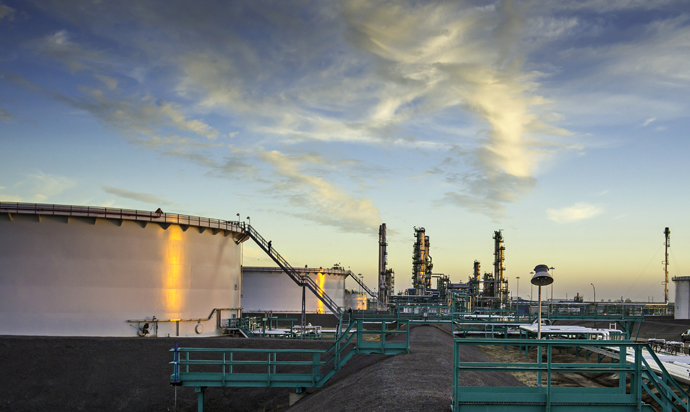
Co-op’s Regina refinery is indisputably local
Federated Co-operatives Limited, the parent of the Co-op Refinery Complex, operates under, as the name suggests, a co-operative structure. It’s owned by its grass roots, some 190 retail co-operatives. The tumultuousness of the Great Depression in the 1930’s compelled its original members to band together for survival. The pact stuck.
Among its more interesting endeavours, today’s Co-op supplies the majority of Prairie farmers with their agricultural fuel, employs more than 1,000 people at its refinery operation, and recently invested in a $200 million Wastewater Improvement Project to clean and recycle wastewater.

We had a chat with Gil Le Dressay, Vice-President, Refinery Operations, Co-op Refinery Complex in Regina to learn more about what it’s like to work at the refinery and what makes the organization unique:

Canadian Fuels – Why do you choose to work at Co-op?
 Gil Le Dressay – I’ve spent nearly my entire working life at Co-op and with the Co-op Refinery Complex. There are many great aspects to working for the Co-op. We have great people and those people take pride in what they do, and that pride is passed on from generation to generation. It’s a real sense of community in the Co-op system. As a Co-op, we help build sustainable communities by working with the people in those communities that we have a presence in. At the Refinery, we say we Fuel Western Canada but we do that together with our retail owners and to me that big community is a really important part of why I have chosen to stay for so long. We’re part of something bigger as a Co-op employee.Your organization places clear emphasis on community involvement. Why is it important to define your company as a caring actor in the region it serves?Your Wastewater Improvement Program was recently recognized with an Exceptional Engineering and Geoscience Project Award by the Association of Professional Engineers and Geoscientists of Saskatchewan. What makes the way you treat wastewater exceptional?We are the only Refinery in North America that can clean and recycle all of our wastewater for the purposes of steam production. That means we are taking Refinery wastewater from heavy oil processing and turning into pristine clean water. In order for us to recycle the water back into our systems, we must remove solids such as salts and metals that may have accumulated during the process. If we don’t, it can foul our equipment and cause issues, so it has to be very clean. We are now capable of cleaning and recycling up to 2 million gallons of wastewater per day.The fuels market is changing because politicians are responding to heightened awareness of environmental matters. As priorities shift to ecologically sensitive energy sources, how is the petroleum refining sector prepared to stake a claim to that market?One thing people may not know is that the refining industry is always looking to be more efficient. We make massive investments in safety and reliability every year with the goal that we will be more energy efficient, we will be more reliable and environmentally sound. Our industry is a massive driver of technological advancements and like most industries, we are always pushing to do better because it helps both the communities we are located in and our business.What, for you, is the most exciting thing going on at the Co-Op refinery right now? For me it’s always about the improvements were making and the ingenuity and innovation of our people. Our team is always looking at enhancing our facility from major capital projects through to better asset management and minor operational tweaks. All have a major impact on improving our performance, and it is the people that really drive these improvements. A few years ago we changed our Vision at the Refinery – It now says we want to be a recognized leader in safety, reliability and sustainability within our industry. Our people are working towards that vision every day and that’s what excites me most.What’s the greatest thing that policymakers could do to support your organization?
Farmers’ refinery co-op in Regina was borne out of need
Canadian Fuels Association Blog Nov 23, 2017
People, process, and product: the perfect balance for engineer Gurpreet Bhatia
Canadian Fuels Association Blog Mar 22, 2018
Appointment Notice – Cal Fichter to Association Chair
Canadian Fuels Association News June 27, 2018

