
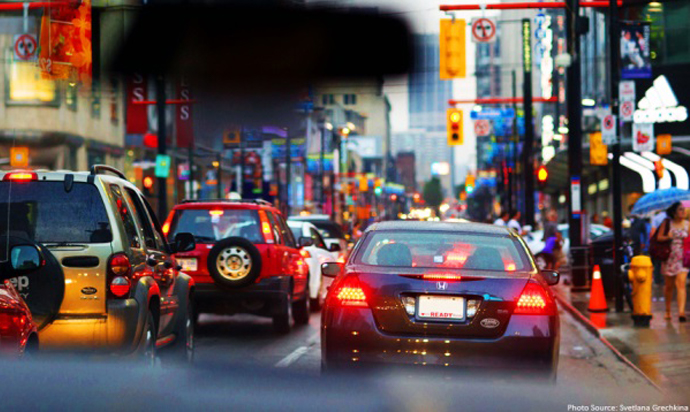
Road design, autonomous vehicles part of solution to traffic woes
Take heart, frustrated motorist, your worst traffic problems may soon be a distant memory thanks to road design and tech.
In the meantime, take a live look at one of Canada’s most congested traffic spots Highway 401 and 427 in Toronto. Is it bad? If you’re watching during rush hour, you’re probably witnessing a lot of stopped cars. The red on this Google Map displaying typical congestion at 8:30AM shows the extent of the problem:

The issue is not unique to Canada’s biggest city. On CAA’s ranking of Canada’s 20 worst bottlenecks, Toronto makes 10 appearances, Montreal makes five, Vancouver makes four, and Quebec City is listed once.
In the 20 years preceding the 2016 federal census, 2.8 million more people chose to drive to work, Statistics Canada reports. Torontonians have the longest commute in Canada, averaging 34 minutes, the census shows. It appears that Canadians’ love for personal mobility continues, despite the in-car commute time. The reason may be due to the significantly longer commuting time using transit than personal vehicles. In many cases, this time is doubled, according to the census.(i)
However, there are solutions to the traffic problem.
Vehicle automation is lining up to play a role in easing congestion by address the imperfect efficiency inherent in human nature. Researchers at Ford and Vanderbilt University(ii) found that Ford’s Adaptive Cruise Control (ACC), a system that automatically accelerates or breaks in response to traffic could significantly reduce phantom traffic jams which are created by human inefficiency (as opposed to actual traffic events such as accidents).
Highway and interchange design can also have a place in reducing congestion. Roundabouts and a different kind of highway interchange called the diverging diamond, long used in France processes traffic more efficiently. The first of its kind in Canada opened in Calgary in 2017.(iii)

[The Diverging Diamond or Criss-Cross Interchange is slowly being adopted in North America]
Tech-savvy motorists often find it’s easier to avoid the trouble spots. Modern GPS applications can take into account live traffic statuses enabling motorists to circumvent the red zones. Google’s Waze crowdsources user data to develop an impression of traffic speed. Other options are INRIX, Navmii, and the less-catchy-named GPS Navigation & Offline Maps Sygic. With varying results, the apps’ directions can guide users around clogs and snarls.
But what if the traffic network as a whole analyzed and responded to traffic conditions? That’s the reality in 27 nations that have implemented Australia’s SCATS system. Cities using SCATS and, systems like it, have traffic-light cycles that lengthen and shorten as needed and that communicate with one another as a system, all with minimal human intervention. In 2017, Toronto launched a pilot program to test two similar technologies at locations along Young Street and Sheppard Avenue East.(iv)
Generational differences might also contribute favourably to the problem of congestion. As Canadian Fuels Association reported in a recent blog entry, millennials are buying cars but later in life than previous generations and urban dwellers are using ride-sharing and public transit more interchangeably.
The common denominator among all these solutions will be efficiency and consumer preference towards the potential to keep more traffic moving along.
_______________________
i] (i) https://www150.statcan.gc.ca/n1/pub/11-627-m/11-627-m2017038-eng.htm
Related:
5 tips for a fuel-efficient fall
8 ways transportation makes Canada’s economy tick
How eco-driving saves on fuel


